
Implementing REZCET Teaching at Hue University of Agriculture and Forestry (HUAF)
Case Study: Implementing REZCET Teaching at Hue University of Agriculture and Forestry (HUAF)
From Pilot Training to Developing Student Capacity in Agriculture, Forestry, and Fisheries
1. Background
In the trend of energy transition and Net Zero commitment, the Agriculture, Forestry, and Fisheries sector plays a crucial role in emission reduction and sustainable development. However, in Vietnam, the content of Renewable Energy – Zero Carbon Emission – Energy Transition (REZCET) has not yet been fully integrated into university training programs.
To bridge the gap between training and practice, Hue University of Agriculture and Forestry (HUAF) has collaborated to implement a pilot REZCET teaching model, focusing on students of the Faculty of Soil Resources and Agricultural Environment in the 2025–2026 period.
2. Objectives of the Teaching Model
This case study aims at three main objectives:
Enhancing awareness and foundational knowledge of REZCET for students in the Agricultural Science and Technology major.
Innovating teaching methods, enhancing experiential learning and project-based learning.
Connecting training with local practices and guiding students towards green career paths.
3. Target Audience and Scope of Implementation
Target Audience: 25 students in their first to fourth years from the Faculty of Soil Resources and Agricultural Environment, and 25 students from the Faculty of Rural Development and the Faculty of Animal Husbandry, HUAF.
Time: 5 days (3 days of classroom instruction, 2 days of fieldwork)
Format: Integrated teaching – theory – practice – fieldwork
4. Design of REZCET Teaching Content
4.1. Main Learning Content
The program is designed in an interdisciplinary and applied approach, including:
ReZCET Overview: Concept, Global Trends, and the Vietnamese Context
REZCET Policies and Prospects in Agriculture, Forestry, and Fisheries
REZCET Applications in Agricultural Production
The Role of AI and Digital Technology in Energy Transition
Developing a REZCET Model Concept Based on Local Conditions
4.2. Teaching Methods
The REZCET teaching model at HUAF applies a learner-centered approach, combining:
Presentations – discussions – Q&A
Group discussions and idea presentations
Project-Based Learning
Experiential learning through field trips
5. Field Trips: A Bridge Between Theory and Practice
Students will visit and learn at:
Aquaculture farms integrating renewable energy
Solar energy businesses
Ecotourism models using renewable energy
Field trips help students:
Understand how renewable energy systems operate
Identify opportunities and challenges when applying REZCET locally
Connect academic knowledge with the real-world production context
6. Results and Impacts
6.1. Student Evaluation
84% of students rated the training topic and content as “Very Good”
Fieldwork received the highest rating
The level of understanding and application of REZCET knowledge increased significantly after the course
6.2. Learning Products
Field reports from groups
06 REZCET project ideas
02 models selected for pilot implementation:
“Automatic drip irrigation for fruit trees integrated with solar energy” (implementation 2026)
7. Challenges and Solutions
Challenges
Lack of diverse REZCET models in the locality
Students unfamiliar with project-based learning methods
Large number of students participating in fieldwork
Solutions
Expand the scope of fieldwork model selection
Divide learning groups appropriately, with instructors in charge
Strengthen step-by-step guidance when developing project ideas
8. Lessons Learned
Case study at HUAF shows:
Effective REZCET teaching requires a combination of theory – practice – fieldwork
Experiential learning is a key factor in helping students deeply understand
REZCET should be integrated in an interdisciplinary way, linked with AI and Digital Transformation
9. Scalability
The REZCET teaching model at HUAF can:
Be applied to other faculties in the university
Be replicated to other agricultural, forestry, and fisheries universities nationwide
Become a model for training green human resources for Vietnam in the 2025–2030 period
10. Conclusion
The case study of REZCET teaching at Hue University of Agriculture and Forestry shows clear effectiveness in innovating university education, contributing to improving student capacity and preparing human resources for sustainable agriculture and energy transition. This is an important prerequisite for developing large-scale REZCET training programs in the future.
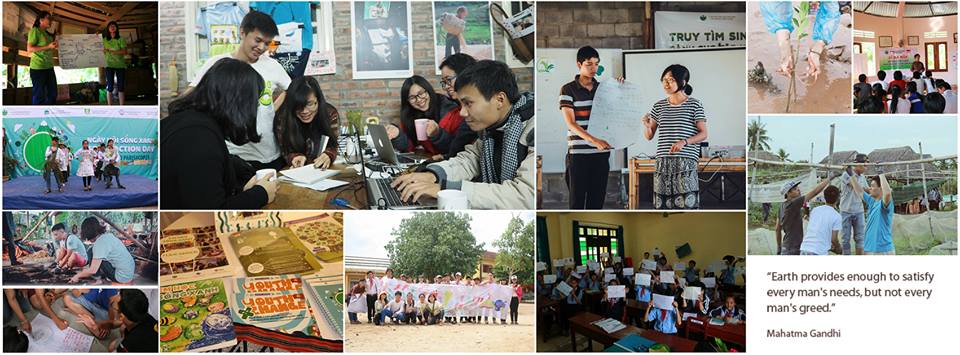
Some images from the program


